   |
 |
 |
 |
 |
| Sat 10 Oct 2026 |
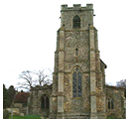
The History Of All Saints' WickhambrookThe IncumbentsPeter de VoyseryThe first known incumbent obtained "Protection to Peter de Voysery parson of Wickhambrook, for three years, going beyond seas with Amadeus, Count of Savoy" (Patent Rolls 27) in the year 1299. The discovery of a coffin constructed from a block of limestone under the purbeck marble slab in the north aisle chancel (2) dated earlier than 1275 would suggest that the church was partly built before his term of office. The church was consecrated in 1311 as All Saints'. Edward de MarcleshamThe second incumbent was Edward de Marclesham in 1312. We learn from the Close Rolls 6, Edw. 11, that "Edward de Marclesham, parson of the church of Wickhambrook, acknowledges his debt of £16.13s. 4d. to John Vaune and his fellows of the Society of the Ballardi of Lucca, to be levied in default of the church and chattels of his in Suffolk". A hundred years later, a weekly wage for a carpenter was 2s. 10d. and a sheep cost 2s. 1d. - so his debt was a considerable one! John de FleteAccording to the Patent Rolls of 1338, John de Flete the sixth incumbent was King's Clerk and in the same year was appointed Keeper of the King's Jewels in the Tower of London and Keeper of the King's Exchanges in London and Canterbury. Simon of SudburySimon Theobald, or Simon of Sudbury, was born in 1317 and became powerful in the service of church and state. He was appointed Papal Nuncio to Edward III in 1356 and became Archbishop of Canterbury in 1375. In 1380, as Chancellor of England, he imposed the poll tax which, necessary though it may have been, was one of the oppressive acts of government that kindled the Peasants' Revolt. Refuge with King Richard II in the Tower did not save him from the mob that beheaded him messily on Tower Hill on 14 June, 1381. Although associated with All Saints' Wickhambrook he was also instrumental in other churches locally. 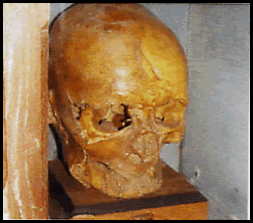
Skull of Simon de Sudbury He made significant changes at St Gregory's, Sudbury, Sufolk. With his brother, he founded a college of canons in 1375 (of which only the gateway remains west of the church) and built an extended chancel for their use. The north aisle of the 1370s was also his work and a chapel dedicated to All Souls in memory of his parents now houses the organ. Just within the church stands a fine mahogany chest, with a brass plate on top bearing the arms of the borough incorporating Simon's own heraldic talbot badge, and engraved with the names of the churchwardens for 1785. A reminder of Simon of Sudbury's college is the fine range of stalls with misericords in the chancel. His talbot badge may be found on the first stall on the south side and there is a particularly good head midway along the north side. A consecration cross is painted on the wall by the vestry door, and there is Simon's skull (parted from his body which is buried at Canterbury) and kept in a recess in the vestry wall - a grisly relic decently concealed behind a little green door.
William Talmage or TalmacheUp until the time of Henry VII, All Saints' was really an outpost of the Monastery at Ely. In 1534, Henry VIII abolished the Papal power in England and four years later Pope Paul III excommunicated him and Parish Registers were established. The Revd William Talmage or Talmache was then appointed vicar, remaining in office until 1558 - the first year of Elizabeth I's reign. He spanned the early years of the Reformation and the dissolution of the monasteries, the Act of Uniformity, the first and second Prayer Books in the reign of Edward VI, the reaction under Mary and the return of the reformed church by Elizabeth in 1558. Thomas GrayThe Revd Talmache was luckier or more pliable than the Revd Thomas Gray, appointed vicar in 1645. He was driven out of the living by order of Oliver Cromwell after the King's execution in 1649. During the time of Cromwell, the church building was damaged, probably by William Dowsing. The corbels on the nave arches on the south side of north aisle arches were smashed in a way that is characteristic of the vandalism carried out by him. The stained glass windows were knocked out except for a small portion at the top of a window on the south side of the chancel. The parish was without a vicar for ten years and administered by a Commissioner until the appointment of the Revd John Cooper in the year Cromwell died. Under the rule of the Puritan Commissioner, no baptisms were recorded in the parish registers, although a list of births was kept. The Revd Cooper continued this practice, but at the restoration of the monarchy he returned to the old practice of recording baptisms. Ian FinnBorn in Lancashire 1958, Ian attended St John's Primary School and Accrington Grammar school for boys. He then went on to attend Kings College, London and gained an AKC in Theology. Ian returned to Lancaster and worked as an Auxiliary Nurse and Occupational Therapy helper for a couple of years before attending Chichester Theological College. Ian was ordained Deacon in 1982 in Blackburn Diocese and Priested in 1983. He served his Curacies at All Saints, Burnley and the Church of the Ascension, Morecambe, going on to become Vicar at Christ Church Lancaster and then St Nicholas Church, Tillingham, Essex. Between 1997 and 1999 Ian became Chaplain and Head of Religious Education at Worcester Royal Grammar School. He moved to Bansfield Benefice, Suffolk looking after 7 rural parishes between 1999 and 2007. During this time he was Chair of Governors at a middle school and a primary school. In 2006 he was licensed as Rural Dean of Clare. Ian gained an MA in Pastoral Theology and became Rector of Haverhill and Withersfield Benefice in June 2007. In November 2011 he was installed as an Honorary Canon of St. Edmundsbury Cathedral. Ian is a proud father of three and in his spare time, he enjoys reading, walking, art, sports and his big love of Landrovers. |

